🎯 About the Summit
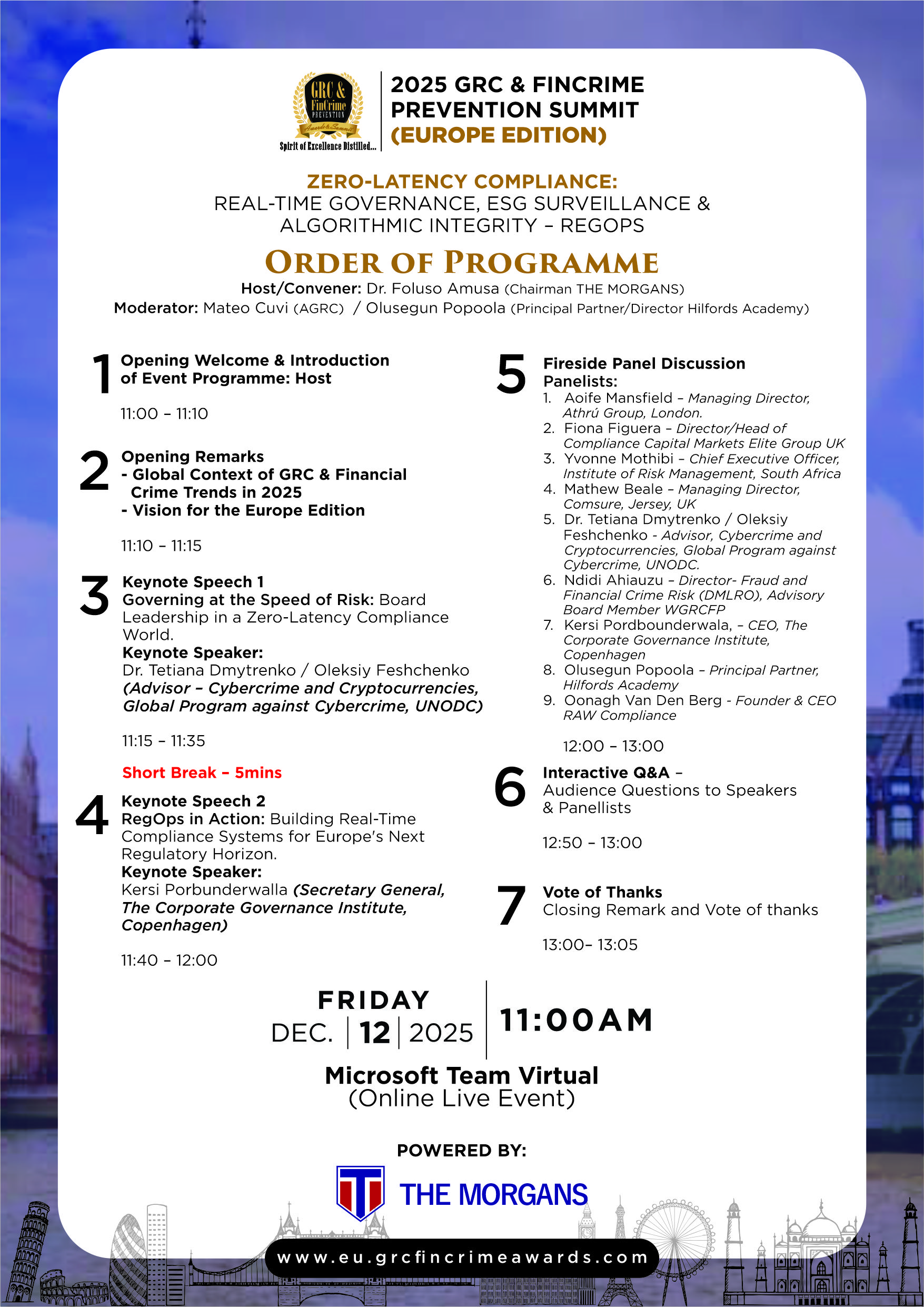
The GRC & Financial Crime Prevention Summit 2025 is a strategic gathering of
industry leaders, innovators, regulators, and professionals committed to safeguarding
institutions and communities from the growing complexities of governance, risk,
compliance (GRC), and financial crime.
Held at a pivotal point in the year, this summit provides an essential pulse-check on
how organisations are adapting to the convergence of AI, ESG, and digital compliance to
stay ahead of emerging threats, regulatory shifts, and technological disruption.
đź’ˇ Why This Theme?
The Zero-Latency Compliance: Real-Time Governance, ESG Surveillance & Algorithmic
Integrity – RegOps Summit brings together senior leaders from the public policy,
regulatory, governance, risk & compliance, technology, and ESG fields. Over one
to two days, participants will explore how organisations and governments are evolving
their regulatory-operations (“RegOps”) practices to keep pace with rapid change,
digitalisation, stakeholder demands and emergent risks.
- Acceleration of real-time data and monitoring capabilities
Advances in big data, IoT, sensors, streaming analytics and machine learning mean that organisations and regulators can increasingly monitor ESG,
governance and compliance metrics on an ongoing, live basis. Research shows that real-time ESG analytics with big data and AI can enable continuous
monitoring of sustainability performance, moving beyond static reporting. This shift demands a re-thinking of compliance operations to handle
zero-latency signals, anomalies, and dynamic risk.
- Growing regulatory and stakeholder pressure on ESG and governance
ESG (Environmental, Social, Governance) disclosure standards are increasing globally, and stakeholders (investors, civil society, regulators)
demand greater transparency. Technology is playing a key role in enabling ESG measurement and governance frameworks.
Impact Investing Conferences. Under this pressure, compliance regimes cannot wait for periodic audits. They must embed continuous monitoring and governance,
thus aligning with real-time governance.
- Risks of algorithimic decision-making and integrity-failures
As organisations deploy automated systems, AI/ML models and algorithmic decision-making in compliance, governance and ESG domains, there is elevated risk
around fairness, transparency, bias, unseen errors, and integrity. A recent study on “algorithmic integrity” in public procurement shows how predictive
frameworks can detect corruption patterns in real time. Addressing algorithmic integrity, ensuring models are accountable, auditable and aligned with governance expectations, is hence a core part of modern RegOps
- Need for integrated, holistic RegOps approach
Historically, compliance, ESG oversight and algorithm governance have been siloed functions. But the emerging reality is that they overlap: ESG data is
increasingly algorithmically processed, governance frameworks require real-time operationalisation, and regulatory operations must account for digital and
methodological risk. Thus, the theme emphasises the integration: “Zero-Latency Compliance” captures the live-monitoring dimension; “Real-Time Governance,
ESG Surveillance & Algorithmic Integrity” captures the three pillars; “RegOps” signifies the operational, process-oriented lens.
- Relevance for developing markets and public policy contexts
For countries and organisations in emerging markets—such as in Africa or Asia—there is a heightened urgency: governance systems are under pressure, data
infrastructures are rising, ESG expectations are globalising, and algorithmic solutions are being adopted rapidly. A summit with this theme is well-placed to
address the realities of implementation, capacity-building, risk mitigation and policy adaptation in those contexts.
đź’ˇ What to Expect
Expert Keynotes Addresses
Hear from global thought leaders on how real-time data, algorithimic monitoring and governance frameworks are reshaping GRC and ESG compliance.
Panel Sessions on ESG Surveillance
Monitoring environmental, social and governance metrics in an era of live data flows and rapidly shifting stakeholder expectations.
Workshops and break-outs on algorithmic integrity
How to ensure the models, automated systems and decision-making engines driving compliance operations are transparent, auditable and aligned with ethical/ regulatory standards.
Case Studies & Industry Applications
Case-studies from both public sector (regulators, government agencies) and private sector (corporates, financial institutions, tech vendors) on implementing real-time governance and RegOps solutions.
Networking & Collaboration Opportunities
A networking forum for regulators, technologists, ESG specialists and compliance professionals to exchange practical lessons, tools, and strategic insight.

đź’ˇ Who Should Attend?
- GRC, Risk, and Compliance Professionals
- Financial Crime & AML Specialists
- Chief Risk & Compliance Officers (CROs, CCOs)
- ESG & Sustainability Leads
- Legal, Audit, and Ethics Executives
- Data & AI Strategy Leaders
- Regulators, Policymakers, and Law Enforcement
- Technology and Innovation Officers
- Academia, Researchers, and Students in GRC-related fields